From Institutions to IDEA: The Real History of Special Education"
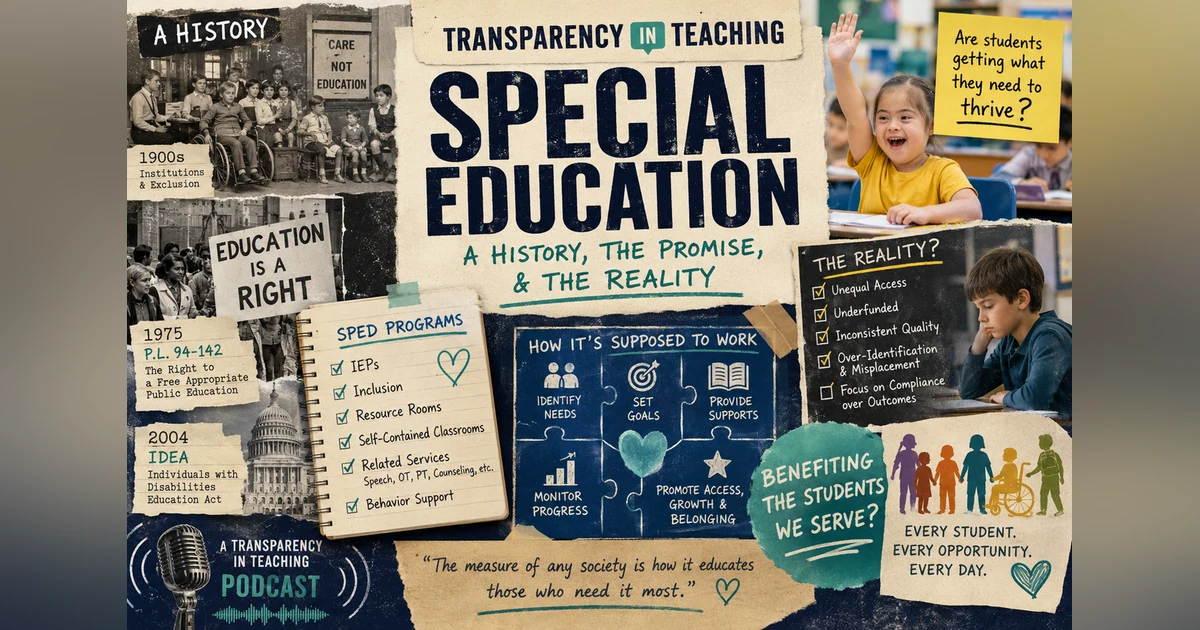
Get ready to get deep into the realm of Special Education. As a general ed teacher, I've had a love-hate relationship with how best to work with special education students and the teachers who support them. While I understand the necessity, the implementation in a general education classroom often felt awkward and overwhelming. I'm sure I'm not alone in this. I'm also sure our special education teachers have similar grievances when dealing with general ed teachers.
So I decided to do a deep dive to better understand the history of our SPED programs, how they are supposed to work, and whether they are really benefiting the students they serve.
This deep dive was too big to fit into a single episode, so Jen and I decided to create several episodes to give this topic the time it deserves.
Welcome to Episode One:
The History of Special Education (SPED)


 RSS Feed
 Get ready to get deep into the realm of Special Education. As a general ed teacher, I've had a love-hate relationship with how best to work with special education students and the teachers who support them. While I understand the necessity, the implementation in a general education classroom often felt awkward and overwhelming. I'm sure I'm not alone in this. I'm also sure our special education teachers have similar grievances when dealing with general ed teachers.
So I decided to do a deep dive to better understand the history of our SPED programs, how they are supposed to work, and whether they are really benefiting the students they serve.
This deep dive was too big to fit into a single episode, so Jen and I decided to create several episodes to give this topic the time it deserves.
Welcome to Episode one:
The History of Special Education (SPED)
In this episode of Transparency in Teaching, Jen and I dive deep into the history of special education (SPED) in the United States. We start with a light-hearted conversation about Jen's rigorous walking routine, but quickly transition into the main topic: the evolution of special education. In this episode we discuss:
-
Early Days of Special Education:
-
Initially, children with disabilities were often institutionalized or kept at home with no formal education.
-
Wealthier families could afford private tutors or specialized schools, but most families had limited options.
-
Legislative Milestones:
-
A series of laws from 1958 to 1968 began addressing the needs of children with disabilities, but these were piecemeal efforts.
-
Notable acts included the Captioned Films Act (1958), the Training of Professional Personnel Act (1959), and the Elementary and Secondary Education Act (1965).
-
Major Legal Cases:
-
Brown vs. Board of Education (1954): Although primarily about racial desegregation, it laid the groundwork for arguments against segregating children with disabilities.
-
PARC vs. Commonwealth of Pennsylvania (1971): This case established that children with intellectual disabilities had the right to public education.
-
Mills vs. Board of Education of D.C. (1972): Extended the right to free public education to all children with disabilities, regardless of the cost.
-
The IDEA Act:
-
The Education for All Handicapped Children Act (1975), later renamed the Individuals with Disabilities Education Act (IDEA), guaranteed a free appropriate public education (FAPE) to all children with disabilities.
-
This act has been reauthorized multiple times but has not been updated since 2004.
-
Current Challenges:
-
The IDEA Act is outdated and needs reauthorization and updates to address current educational needs and funding issues.
-
The Americans with Disabilities Act (1990) further ensured accessibility in public spaces, including schools.
-
Jen's Perspective: She is struck by how long it took for meaningful changes to occur and empathizes with the struggles of parents both past and present.
-
Anne's Perspective: She is concerned about the IDEA Act's outdatedness and the lack of recent updates to address current educational challenges.
We wrap up by encouraging listeners to reflect on the history of special education and its impact on today's educational landscape. We also tease the next episode, which will delve into the current state of special education, including enrollment numbers and costs.
Listeners are invited to share their thoughts and experiences related to special education on our website, TransparencyInTeaching.com, where they can also find past episodes and blog posts.
Key Points Discussed: Reflections and Takeaways:Conclusion:Call to Action: